





The plagues. Which, if you will recall, god has called down on Pharaoh for refusing to release the Israelites. Which god caused him to do.
Chapter 7
God comes back and tells Moses that he and Aaron are going to speak to Pharaoh again, and eventually Pharaoh is going to give in. He promises again to harden Pharaoh's heart and rain down plagues as punishment. After that, they Egyptians shall know that I am the LORD (v. 5). Somehow, I think Pharaoh isn't the only crazy boss in this book.
Moses is now 80, and Aaron 83, which isn't particularly helpful, as we don't know how old they were when this started. God comes to them again and says that Pharaoh is going to ask them for a miracle. They're to do the trick with the rod-as-serpent. They do, and Pharaoh calls up his magicians, who do the same trick, but luckily Aaron's serpent eats all the others.
God hardens Pharaoh's heart again, and then points it out to Moses. He tells him to go down to the river when Pharaoh is bathing and to smite the river so the water turns to blood, which will kill the fish and it will smell and nobody will want to drink it. He tells him to stretch out his hand and this will happen to all the water in Egypt.
Everything goes as predicted, and then for some reason, the Egyptian magicians also turn the waters to blood and nobody can drink. Pharaoh's response is to go into his room and sulk. The Egyptians dig wells all over, but can't find water. This goes on for a week.
So that's the first plague, the plague of blood.
Chapter 8
Frogs!
Jerry does have one useful thing to say about all of these plagues, that they are directed against specific Egyptian deities. If only all of his commentary could be that informative, rather than trying to justify his worldview. This particular plague is against the fertility goddess Heket, who was depicted as a woman with a frog's head. She breathed life into the bodies that her husband fashioned out of clay. So these frogs, normally a sign of fertility, were transformed by the Israelite god into a blight. See, now that's the kind of interesting historical fact that I want to get out of reading this book!
God tells Moses to go again to Pharaoh and threaten him with frogs, frogs everywhere. The magicians do the same thing. Why, exactly? Anyway, Pharaoh calls them to him and says that if god takes the frogs away, he'll let them go make their sacrifices. Moses, stupid fool, doesn't get it in writing, and asks when Pharaoh wants the critters gone. Uh, tomorrow? Moses goes and tells god about the agreement. Of course, Pharaoh forgot to say where the frogs should go, so they all just kind of die where they are, which stinks. Pharaoh renegs on his agreement, possibly of his own accord here.
His punishment is that Moses and Aaron are now to smite the dust of the land so it becomes lice. Gross! The magicians try this one, but aren't able to, so they admit to Pharaoh that it's the finger of god. Pharaoh's heart was hardened (v. 19), so it would seem god is acting upon him again. He just loves the punishment, doesn't he?
God tells Moses that he's to go to Pharaoh and threaten him again, or the next punishment will be flies, but only for the Egyptians. Goshen will be left alone. It happens, and the land is corrupted (v. 24). Pharaoh relents a little and says they can go sacrifice some sheep. Now it isn't good enough, because the Egyptians think sacrifices are an abomination (and really, who disagrees?) and they'll stone them. They have to go into the wilderness for three days. Pharaoh agrees, as long as they don't go too far. He even asks them to make a sacrifice for them. So Moses agrees to call off the flies the next day, but he's smarter now and Makes Pharaoh promise to hold to his promise, but still doesn't get it on paper. God does as asked, and Pharaoh again goes back on his word, this time of his own volition.
Chapter 9
God tells Moses again to go to Pharaoh, this time to threaten him with murrain (v. 3), which is an unspecified livestock disease. The Israelites will again be spared. Apparently, this was an insult to several Egyptian gods, and the Egyptian practice of animal worship, which of course most cat owners are familiar with. Pharaoh has his heart hardened for him, and all the livestock die.
God tells Moses and Aaron to go gather some ashes, then throw it in the air in Pharaoh's sight. The ashes will turn to dust which will raise boils on all the men and remaining animals (presumably the ones that didn't die). The magicians have no response to this, they can't even get up the boils are so painful. God hardens Pharaoh's heart again.
God tells Moses to go again and threaten Pharaoh with even more plagues, so the Egyptians will know there is none like me in all the earth (v. 13). This time he'll sent pestilence against the people. He says he has done this to Pharaoh as a demonstration of his own power, and to make himself more famous but Pharaoh has only exulted himself and refused to let the Israelites go. Prima donnas, these two.
So God says tomorrow he's going to send hail, so he'd better put the cattle (which he just killed, mind) in the barns and harvest the crops today. Some of the Egyptians have learned by now, and they do as they're told, but not all. And Moses stretches out his hands and brings forth the hail.
Is everyone out there familiar with the Milgram experiments, in which people in lab coats told participants to electrocute another 'participant' (who was really a collaborator), whenever they got a wrong answer, and they did, even when the other person complained about his heart condition, screamed, and ceased to respond? 26 out of 40 continued to the very end, administering 450-volt shocks, though all expressed discomfort at doing so. Moses has no compunctions here about unleashing all of these plagues on his fellow human beings. Just pointing this out.
The plague is more than hail, it's also fire, and it kills every man, beast, plant and tree, except in Goshen. Pharaoh calls them to him again and says he has sinned, the lord is righteous and his people are wicked. He asks them to ask god to end the plagues, and they can go. Moses still doesn't get it in writing and promises to go ask God to end the hailstorms. He also says he knows Pharaoh still isn't a true believer, and that even though the flax and barley have been destroyed, the wheat and rye weren't. Moses leaves and the storms end, and god hardens Pharaoh's heart yet again, and the people of Israel still aren't free.
Chapter 10
God sends Moses to Pharaoh once again. He tells Moses that he's mostly doing this to be remembered. As what, a mass murderer? It just occurred to me that Pharaoh is a lot like the movie Being John Malkovitch here. He's never in control of his own brain.
So Moses and Aaron go yet again and ask him how much longer he's going to refuse to humble himself in front of the lord, and to let the Israelites go. If he doesn't do it by tomorrow, the next plague will be locusts, which will eat everything the hail didn't kill. Pharaoh's servants are convinced, and Pharaoh calls them to him and tells them they can go but also wants to know who's going with them. Moses says they all need to be there. Pharaoh says only the men.
God tells Moses to call forth the locusts, and they eat everything. Then a powerful wind comes up and brings the locusts, which darken the land (an insult to the sun god, Ra), which eat everything green. Pharaoh calls them and admits that he has sinned against all of them. He asks them to get god to lift the plague. He does, and the locusts are swept into the sea. But god hardens Pharaoh's heart again.
God makes the darkness explicit and snuffs out the sun for three days. Only the Israelites have light. Pharaoh lets them all go, men, women, children, but no animals. Moses says they need the animals to sacrifice. God hardens Pharaoh's heart again. Pharaoh kicks him out, saying if he sees him again, he'll kill him. Moses says buh-bye.
Chapter 11
God isn't finished yet. He tells Moses that he's got one more plague, and this one will finally convince Pharaoh, and he'll not only let the Israelites go, he'll kick them out. He tells Moses to go to his people and tell them to borrow their neighbour's silver and gold. We are told that the lord favours the Israelites and especially Moses.
Moses says that god has told him he intends to go out at midnight and all the first-born sons in Egypt, from Pharaoh's kid to the maidservant. He's also going to kill the firstborn animals. The people of Egypt will cry, but not the Israelites, because they'll be spared. This will finally convince the people to bow down to him and send them away. He tells Moses and Aaron to threaten Pharaoh with even more monstrous deeds if he doesn't listen. And of course god hardens Pharaoh's heart. What do they tell Christians about this in Sunday school? Guess what, kids? Our god is a mass murderer of children! Just so he can be more famous! Of course Jerry has nothing to say on this except that it's a disaster for the Egyptians.
Chapter 12
God tells Moses and Aaron that he is resetting the calendar from today. In 10 days' time all the families of Egypt are to take a lamb, borrowing one if necessary. It's to be a pretty lamb, male, under a year, either a sheep or a goat. They'll fatten it for 4 days, then kill it on the last evening. They're to take the blood and paint the doors, then eat the meat. They can roast it, and spice it and eat it with unleavened bread. They may not eat it raw, or boil it. They have to leave it intact, and if they don't finish it, they have to burn the remains. They have to eat it in haste, dressed and ready to go. The reason: that night he's going to go through Egypt, killing all the first-born sons in the houses with unpainted doors. That's why Jews eat lamb at Passover! What a heartening story to tell your children!
He tells them to keep this day as a sacred feast. Afterwards, they're to eat unleavened bread for seven days, and to kick out anyone who eats the leavened kind. They have to have sermons on the first and last days, and no work except cooking can be done. He's very strong on the leavening part, going on for 4 verses about it before Moses cuts him off. Moses gives these instructions to the Israelite leaders.
God then does as he said he would, and all Jerry has to say about this mass slaughter of children is that the Pharaoh he has chosen as best fitting his biblical time frame, Amenhotep II, was succeeded by Thutmose IV, who was not his firstborn son, so it must be true, even though we don't know what happened to the firstborn, and he doesn't cite any other references to any of the other plagues.
The Egyptians cry, as anyone would, and Pharaoh calls Moses and Aaron to him. He tells them to leave with their children and herds. They go taking their unleavened dough, and they 'borrow' their neighbours' silver and gold, and they also plunder. Then they leave.
Six hundred thousand people go, and they bake the unleavened bread. They had been there for 430 years, and people still celebrate that night.
God tells Moses and Aaron that no strangers can eat at the Passover feast unless they are circumcised. They have to eat everything themselves, no giving food to neighbours.
Sunday, January 31, 2010

Saturday, January 30, 2010
Exodus, Chapters 5 & 6
Chapter 5
This is pretty clearly a labour dispute, as far as I can see. Moses and Aaron are kind of primitive labour organizers, Pharaoh is a classic bully boss, the Egyptians are his minions, and the Israelites suffer.
Moses and Aaron arrive in Egypt and ask Pharaoh to let them take their people into the wilderness for a 3-day bush bash. Pharaoh says no because he doesn't believe in their god. I can't really say I blame him. If I was a boss, and my employees came along and said they needed 3 days off for a religious celebration that involved killing goats in the forest, I'd be like, sure, but you're using your vacation days and I don't want to know anything about it. They claim that if they don't get these 3 days, God is going to either send them a plague or kill them all, which is so not what God said to them in Midian. And all the bosses out there are like, if I had a nickel for every time I've heard that excuse for why an employee needs a long weekend, I tell you, I'd be rich. Pharaoh says no, and tells them to get back to work. He points out that the Israelites are pretty numerous, and a labour disruption of this magnitude will have economic ramifications, so no. He tells his line managers not to gather straw for the Israelites to make bricks with, because apparently they're all brick-layers, but also tells them not to let the Israelits slow down production as a result, or to have any sympathy when they whine about needing to sacrifice for their god. Pharaoh sounds like the 'Bully Boss' from a book I read recently about crazy higher-ups.
So the managers to out and repeat Pharaoh's instructions, and of course there's a disruption in the production cycle, and because they're crazy, they beat them, then ask why the Israelites aren't producing like normal. The Israelites take this up the chain of command and ask Pharaoh why he's being so unreasonable, and explain how the Egyptians are making them go gather the straw. But Pharaoh, being a crazy bully boss, says the problem is they're lazy, and to make up for lost time they can't have three days off. The Israelite supervisors leave, after realizing he's nuts and on the way out they meet Moses and Aaron. They bitch at them that now Pharaoh is angry and might kill them. Moses doesn't have an answer, so he asks god why he's allowing this evilness to happen to his people and remonstrating him for not fulfilling his promise. Ah, the classic problem of evil: if god is all good and all powerful, there ought not to be any evil in the world, right? So either god isn't all powerful, or he isn't all good. Of course, Jerry would wimp out here and only say god created humans with free will, and if they do evil, it's their own fault. But he doesn't even adress this, because he would rather spend half a page explaining how Pharaoh is a pagan, which we knew already.
Chapter 6
God promises to fix Pharaoh, and reminds Moses of his covenant with the Israelites. He promises again to free them from the Egyptians and take them to Canaan. Moses tries again to convince the Israelites, but they aren't having it. God tells him to go to Pharaoh again, and Moses complains that his lack of speaking skills isn't leading to any results.
We then get yet another genealogy of the history of the Israelites since Jacob/Israel. We find out that despite god's decision in Genesis to limit the human life span to 120 years, Levi, Moses' father Amram, and Kohath, one of Levi's sons, all lived to be over 130. We also find out that Moses and Aaron's mother is also their father's aunt.
It all ends with god telling Moses once again to talk to Pharaoh.
This is pretty clearly a labour dispute, as far as I can see. Moses and Aaron are kind of primitive labour organizers, Pharaoh is a classic bully boss, the Egyptians are his minions, and the Israelites suffer.
Moses and Aaron arrive in Egypt and ask Pharaoh to let them take their people into the wilderness for a 3-day bush bash. Pharaoh says no because he doesn't believe in their god. I can't really say I blame him. If I was a boss, and my employees came along and said they needed 3 days off for a religious celebration that involved killing goats in the forest, I'd be like, sure, but you're using your vacation days and I don't want to know anything about it. They claim that if they don't get these 3 days, God is going to either send them a plague or kill them all, which is so not what God said to them in Midian. And all the bosses out there are like, if I had a nickel for every time I've heard that excuse for why an employee needs a long weekend, I tell you, I'd be rich. Pharaoh says no, and tells them to get back to work. He points out that the Israelites are pretty numerous, and a labour disruption of this magnitude will have economic ramifications, so no. He tells his line managers not to gather straw for the Israelites to make bricks with, because apparently they're all brick-layers, but also tells them not to let the Israelits slow down production as a result, or to have any sympathy when they whine about needing to sacrifice for their god. Pharaoh sounds like the 'Bully Boss' from a book I read recently about crazy higher-ups.
So the managers to out and repeat Pharaoh's instructions, and of course there's a disruption in the production cycle, and because they're crazy, they beat them, then ask why the Israelites aren't producing like normal. The Israelites take this up the chain of command and ask Pharaoh why he's being so unreasonable, and explain how the Egyptians are making them go gather the straw. But Pharaoh, being a crazy bully boss, says the problem is they're lazy, and to make up for lost time they can't have three days off. The Israelite supervisors leave, after realizing he's nuts and on the way out they meet Moses and Aaron. They bitch at them that now Pharaoh is angry and might kill them. Moses doesn't have an answer, so he asks god why he's allowing this evilness to happen to his people and remonstrating him for not fulfilling his promise. Ah, the classic problem of evil: if god is all good and all powerful, there ought not to be any evil in the world, right? So either god isn't all powerful, or he isn't all good. Of course, Jerry would wimp out here and only say god created humans with free will, and if they do evil, it's their own fault. But he doesn't even adress this, because he would rather spend half a page explaining how Pharaoh is a pagan, which we knew already.
Chapter 6
God promises to fix Pharaoh, and reminds Moses of his covenant with the Israelites. He promises again to free them from the Egyptians and take them to Canaan. Moses tries again to convince the Israelites, but they aren't having it. God tells him to go to Pharaoh again, and Moses complains that his lack of speaking skills isn't leading to any results.
We then get yet another genealogy of the history of the Israelites since Jacob/Israel. We find out that despite god's decision in Genesis to limit the human life span to 120 years, Levi, Moses' father Amram, and Kohath, one of Levi's sons, all lived to be over 130. We also find out that Moses and Aaron's mother is also their father's aunt.
It all ends with god telling Moses once again to talk to Pharaoh.
Friday, January 29, 2010
Exodus, Chapters 3 & 4
Chapter 3
Moses is in the field one day, tending to his father-in-law Jethro's flocks. Wait! In chapter two, his father-in-law was called Reuel! You can look this up for yourselves, by comparing Chapter 2 verse 18 and Chapter 3, verse 1. So either Moses is yet another unpunished polygamist, or this book is inaccurate. Jerry of course, is mum on the subject. Also, who knew all these hillbilly names were biblical? Have you ever met a Jethro with all his teeth?
I digress. Moses stops in his tracks when an angel appears in a burning bush. Ooh! Fake fire. Good thing this was thousands of years ago, because today's kids wouldn't be impressed. Moses is, though. Suddenly god is also in the flames. So was the angel his secretary, just checking to see if Moses was available, and then he put the boss through? Is this a conference call? He tells Moses to take off his shoes, because this is a holy place now. Picky, picky. Then he introduces himself. Moses hides his face out of fear of god. And rightly so. He still hasn't had any consequences for killing someone in chapter 2.
God admits he finally noticed the Hebrews' suffering, and he's here to take them away from the Egyptians and unto a land flowing with milk and honey (v. 8), in other words Israel. You see why I wanted this version? Milk and honey? Too bad only crazy and/or skeptical interpretations are available. He informs Moses that he's going to go to Pharaoh and take everybody away.
Moses might be easily impressed by special effects, but he's clearly had some legal training, as he asks god why the people should believe him. God's answer is that he will be with them and he'll reward his efforts. Moses is still skeptical, and asks what he should do if they ask what this so-called god's name is. God says to say I AM THAT I AM (v.14) sent him, which doesn't sound very convincing if you ask me. He adds, however, that Moses should say The LORD God of your fathers, the God of Abraham, the God of Isaac, and the God of Jacob (v. 15) which is a much better beginning, I think. He promises this will work, then tells him to gather the tribal leaders together, tell them this story, and to go to Pharaoh and say they've met god and need to go into the wilderness for three days to make sacrifices. So, Pharaoh is like their wives? Instead of honey, the boys and I are going golfing for three days, or in my household, honey there's a debating tournament next weekend, they're going out to sacrifice stuff. And just like an abandoned wife, god is sure Pharaoh will say no. And then he'll smite Egypt, and then they'll be allowed to go. Should ladies who refuse their husbands' 'guys weekends' be afraid of the wrath of god? He also tells Moses that they won't go empty-handed, the women are to 'borrow' silver and jewels and gold and clothing from their neighbours and house guests and put them on their sons and daughters. 'Borrow' in the sense of 'we're just taking it to Israel! I promise to send it back by post!'
Chapter 4
Moses is still skeptical about his ability to convince the people, so god starts doing magic tricks. First, he tells him to put his rod on the ground, and it turns into a snake. Moses runs away. God tells him to pick it up, and it turns into a rod. Is this what those bizarre snake-handling 'Pentecostals' are doing? Oh, no, apparently the relevant passages are in Matthew and Luke, sorry.
God says that will convince them, but if not, put his hand on his chest. Moses does, and when he pulls it away, it's leprous. God tells him to put it back, and it's healthy. Finally, he tells them to take river water and pour it onto the ground. When he does, it will turn to blood.
Moses still isn't done arguing, and says he's not eloquent. God reminds him who make men's tongues, as well as disabilities, and says they'll practice together. Moses still wants him to send someone else.
Finally, god gets pissed off and says he'll use Moses' brother Aaron instead. So was the whole 'kill the male babies' gambit ended after Moses? Did Pharaoh's daughter plead with her father? Did their mother just send all her boy babies down the river, and did they just happened to get rescued? Or was the copy-writer napping? Anyway, god is going to use Aaron as his spokesman only Moses is going to tell him what to say. He's also going to use a rod to do signs (v. 17). Moses is finally convinced and gets Jethro's approval for the plan. Also, god comes along and tells him the people who were pissed off at him for killing that dude are now dead.
So Moses takes his wife and sons to Egypt and god says to him When thou goest to return into Egypt, see that thou do all those wonders before Pharaoh, which I have put in thine hand: but I will harden his heart, that he shall not let the people go. (v. 21). Now here is what Jerry has to say about that last line: "One must remember that God deserves the right to judge sin and the sinner whenever He desires. The sinner is subject to the wrath of God at any point in his life. God has the right to judge sin in any way He so desires the first time one commits sin. It is really the mercy of God that allows the sinner to continue to live." So who the fuck is Jerry or the Moral Majority to support the death penalty or oppose gay rights if it's all up to god? If he really believes what he says he believes, god will do all the punishing necessary, right?
God has further instructions: Moses is to say Israel is his son his firstborn, and he needs him to serve the lord, and if he won't let them go, god will kill Pharaoh's firstborn son.
But god can't even hold to his promises for one verse. At the inn that night, god tries to kill Moses. WTF? Fortunately, Zipporah is swifter on the uptake than me, and immediately understands this newest heavenly temper tantrum. She cuts her son's foreskin off and throws it at Moses' feet, calling him a 'bloody husband', which I'm just going to read as 'negligent bastard who nearly got us all killed'.
God leaves and goes to Aaron, telling him to meet Moses in the wilderness. Moses fills him in and they go together to the tribal elders. The people believe them and they pray together.
Moses is in the field one day, tending to his father-in-law Jethro's flocks. Wait! In chapter two, his father-in-law was called Reuel! You can look this up for yourselves, by comparing Chapter 2 verse 18 and Chapter 3, verse 1. So either Moses is yet another unpunished polygamist, or this book is inaccurate. Jerry of course, is mum on the subject. Also, who knew all these hillbilly names were biblical? Have you ever met a Jethro with all his teeth?
I digress. Moses stops in his tracks when an angel appears in a burning bush. Ooh! Fake fire. Good thing this was thousands of years ago, because today's kids wouldn't be impressed. Moses is, though. Suddenly god is also in the flames. So was the angel his secretary, just checking to see if Moses was available, and then he put the boss through? Is this a conference call? He tells Moses to take off his shoes, because this is a holy place now. Picky, picky. Then he introduces himself. Moses hides his face out of fear of god. And rightly so. He still hasn't had any consequences for killing someone in chapter 2.
God admits he finally noticed the Hebrews' suffering, and he's here to take them away from the Egyptians and unto a land flowing with milk and honey (v. 8), in other words Israel. You see why I wanted this version? Milk and honey? Too bad only crazy and/or skeptical interpretations are available. He informs Moses that he's going to go to Pharaoh and take everybody away.
Moses might be easily impressed by special effects, but he's clearly had some legal training, as he asks god why the people should believe him. God's answer is that he will be with them and he'll reward his efforts. Moses is still skeptical, and asks what he should do if they ask what this so-called god's name is. God says to say I AM THAT I AM (v.14) sent him, which doesn't sound very convincing if you ask me. He adds, however, that Moses should say The LORD God of your fathers, the God of Abraham, the God of Isaac, and the God of Jacob (v. 15) which is a much better beginning, I think. He promises this will work, then tells him to gather the tribal leaders together, tell them this story, and to go to Pharaoh and say they've met god and need to go into the wilderness for three days to make sacrifices. So, Pharaoh is like their wives? Instead of honey, the boys and I are going golfing for three days, or in my household, honey there's a debating tournament next weekend, they're going out to sacrifice stuff. And just like an abandoned wife, god is sure Pharaoh will say no. And then he'll smite Egypt, and then they'll be allowed to go. Should ladies who refuse their husbands' 'guys weekends' be afraid of the wrath of god? He also tells Moses that they won't go empty-handed, the women are to 'borrow' silver and jewels and gold and clothing from their neighbours and house guests and put them on their sons and daughters. 'Borrow' in the sense of 'we're just taking it to Israel! I promise to send it back by post!'
Chapter 4
Moses is still skeptical about his ability to convince the people, so god starts doing magic tricks. First, he tells him to put his rod on the ground, and it turns into a snake. Moses runs away. God tells him to pick it up, and it turns into a rod. Is this what those bizarre snake-handling 'Pentecostals' are doing? Oh, no, apparently the relevant passages are in Matthew and Luke, sorry.
God says that will convince them, but if not, put his hand on his chest. Moses does, and when he pulls it away, it's leprous. God tells him to put it back, and it's healthy. Finally, he tells them to take river water and pour it onto the ground. When he does, it will turn to blood.
Moses still isn't done arguing, and says he's not eloquent. God reminds him who make men's tongues, as well as disabilities, and says they'll practice together. Moses still wants him to send someone else.
Finally, god gets pissed off and says he'll use Moses' brother Aaron instead. So was the whole 'kill the male babies' gambit ended after Moses? Did Pharaoh's daughter plead with her father? Did their mother just send all her boy babies down the river, and did they just happened to get rescued? Or was the copy-writer napping? Anyway, god is going to use Aaron as his spokesman only Moses is going to tell him what to say. He's also going to use a rod to do signs (v. 17). Moses is finally convinced and gets Jethro's approval for the plan. Also, god comes along and tells him the people who were pissed off at him for killing that dude are now dead.
So Moses takes his wife and sons to Egypt and god says to him When thou goest to return into Egypt, see that thou do all those wonders before Pharaoh, which I have put in thine hand: but I will harden his heart, that he shall not let the people go. (v. 21). Now here is what Jerry has to say about that last line: "One must remember that God deserves the right to judge sin and the sinner whenever He desires. The sinner is subject to the wrath of God at any point in his life. God has the right to judge sin in any way He so desires the first time one commits sin. It is really the mercy of God that allows the sinner to continue to live." So who the fuck is Jerry or the Moral Majority to support the death penalty or oppose gay rights if it's all up to god? If he really believes what he says he believes, god will do all the punishing necessary, right?
God has further instructions: Moses is to say Israel is his son his firstborn, and he needs him to serve the lord, and if he won't let them go, god will kill Pharaoh's firstborn son.
But god can't even hold to his promises for one verse. At the inn that night, god tries to kill Moses. WTF? Fortunately, Zipporah is swifter on the uptake than me, and immediately understands this newest heavenly temper tantrum. She cuts her son's foreskin off and throws it at Moses' feet, calling him a 'bloody husband', which I'm just going to read as 'negligent bastard who nearly got us all killed'.
God leaves and goes to Aaron, telling him to meet Moses in the wilderness. Moses fills him in and they go together to the tribal elders. The people believe them and they pray together.
Thursday, January 28, 2010
Exodus Chapter 2
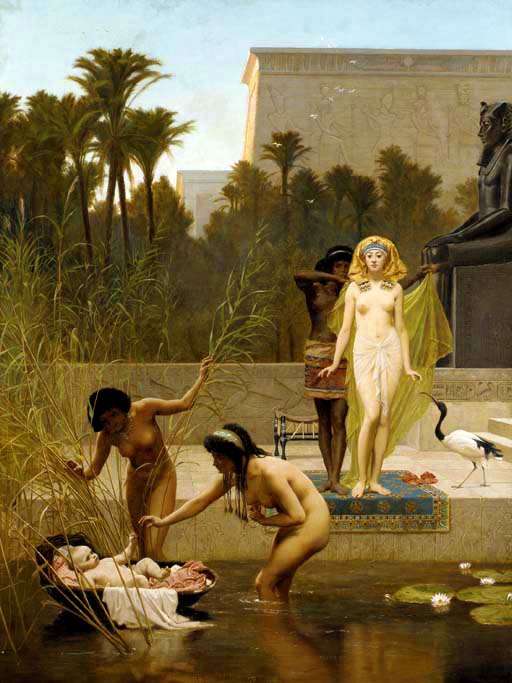
The story of Moses' childhood. You'll be familiar with parts of it, but probably not all of it.
As you well know, Pharaoh had ordered all the male babies killed, but Moses' mother thinks he's too pretty to die, so she makes a little reed boat for him and floats him down the river. Because this is somehow better.
Luckily for Moses, Pharaoh's daughter comes down to wash herself and sees the boat. She instructs one of her maids to got and get it. On opening it, she cries for the poor thing and realises it's a Hebrew baby. Moses' sister, who has been hanging around this whole time, because she's obviously more compassionate than her mother, offers to get a Hebrew nurse for the child. So she gets her mom, and Pharaoh's daughter pays her to nurse him. It doesn't specify when, but presumably after he is weaned, his mother brings him back to Pharaoh's daughter, who adopts him. Now, David Plotz must be reading a different translation than me, or he didn't read thoroughly, because he says Moses wasn't raised at the court, but verse 10 seems clear enough to me: And the child grew, and she brought him unto Pharaoh's daughter and he became her son. And she called his name Moses: and she said, Because I drew him out of the water. Although perhaps that doesn't justify the whole Dreamworks 'Prince of Egypt' version. But neither does the The Brothers Grimm version of Cinderella.
Anyway, it's a pretty thin verse to draw that whole story from, because next thing we know, Moses is an adult. He looks out one day and sees an Egyptian smacking a Hebrew around. He looks around and doesn't see anyone, so he kills the Egyptian and hides him in the sand. I don't think that was in the cartoon version. Was it in the Sunday school version? It was probably less cowardly. Of course, Jerry has nothing to say about this, because Moses is righteous, and righteous people can do pretty much anything, except be gay. Well, except Joseph.
The next day, Moses comes across two Hebrews fighting and asks them why they're at it. They basically tell him to fuck off, since he killed an Egyptian only yesterday. Whoops! He didn't look hard enough!
Pharaoh finds out, of course, and vows to kill Moses, who escapes into Midian. He sits down by a well, and the priest's seven daughters come along to water the flocks. Some shepherds chase them off, but Moses helps them. The girls go home and their father asks them how they're back so quickly. They tell him and he invites Moses for dinner. He ends up moving in and marrying Zipporah, one of the daughters. They have a son, Gershom.
After awhile, the king dies and the enslaved Hebrews cry, and god hears it and remembers them and his promise to Abraham, Isaac and Isreal. After what, 400 years? Why did he let this happen? We have no idea. Better late than never, I suppose, he had respect unto them (v. 25).
Wednesday, January 27, 2010
Exodus, Chapter 1
Oh boy! The story of the Israelites' trials and tribulations in Egypt, aka the book of Moses, the supposed author of the book.
He isn't in chapter one, though. It's just scene-setting. The story has advanced several hundred years and as promised Israel's children have been fruitful and multiplied to the point where Egypt is now in a population crisis, specifically a Hebrew population crisis. The latest Pharaoh (none of them ever gets a name) is worried that there are too many of them, not enough of us. A reverse of Eurabia if you will. What would that be? Cohenic Cairo? Sorry. London, Ontario, Canada, where I grew up, is not exactly the Jewish-joke capital of the world, nor is Rotterdam, Holland, where I live now.
Anyway, he gives the people license to harass the Israelites, but the worse they treat them, the more of them there are. Kind of like Gaza? So they sort of kind of but not really enslave them, and make them build stuff and work the fields and they aren't very nice, but it still doesn't work. They breed like rabbits.
The king finally calls the Hebrew midwives to him and tells them to kill the baby boys but spare the girls. They don't, not because it's barbaric, but because they fear god. As long as no one kills the cute little babies, I suppose. Pharaoh notices, of course and asks them why they didn't obey his commands. They lie and say that Hebrew women are lively (v. 19) and the babies have always arrived by the time they get there. God rewards them for this with houses, and Jerry twists himself in knots saying that the reward is for fearing god, not lying, but for those of us who can just relax and accept that this particular deity punishes and rewards more or less based on which side of the bed he woke up on that day know that it's actually for lying to the big baddie. Anyway, the people continue to breed unfettered. Finally, Pharaoh gets fed up and, since forced sterilization hasn't been invented yet, tells everybody, not just the Jews, to throw their sons into the river and keep the daughters. Great plan! This is going to go over really well, I can just tell!
He isn't in chapter one, though. It's just scene-setting. The story has advanced several hundred years and as promised Israel's children have been fruitful and multiplied to the point where Egypt is now in a population crisis, specifically a Hebrew population crisis. The latest Pharaoh (none of them ever gets a name) is worried that there are too many of them, not enough of us. A reverse of Eurabia if you will. What would that be? Cohenic Cairo? Sorry. London, Ontario, Canada, where I grew up, is not exactly the Jewish-joke capital of the world, nor is Rotterdam, Holland, where I live now.
Anyway, he gives the people license to harass the Israelites, but the worse they treat them, the more of them there are. Kind of like Gaza? So they sort of kind of but not really enslave them, and make them build stuff and work the fields and they aren't very nice, but it still doesn't work. They breed like rabbits.
The king finally calls the Hebrew midwives to him and tells them to kill the baby boys but spare the girls. They don't, not because it's barbaric, but because they fear god. As long as no one kills the cute little babies, I suppose. Pharaoh notices, of course and asks them why they didn't obey his commands. They lie and say that Hebrew women are lively (v. 19) and the babies have always arrived by the time they get there. God rewards them for this with houses, and Jerry twists himself in knots saying that the reward is for fearing god, not lying, but for those of us who can just relax and accept that this particular deity punishes and rewards more or less based on which side of the bed he woke up on that day know that it's actually for lying to the big baddie. Anyway, the people continue to breed unfettered. Finally, Pharaoh gets fed up and, since forced sterilization hasn't been invented yet, tells everybody, not just the Jews, to throw their sons into the river and keep the daughters. Great plan! This is going to go over really well, I can just tell!
Tuesday, January 26, 2010
Genesis Chapters 47-50
Chapter 47
Joseph introduces his brother to Pharaoh, who, just as predicted, asks them what they do, and they tell him they are shepherds. They ask to graze their flocks in Goshen because the famine is bad in Canaan. Pharaoh tells Joseph to give them Goshen, and they can even herd his cattle.
Joseph presents Israel as well, though in this chapter they're calling him Jacob again. Pharaoh asks how old he is, and he says 130 tumultuous years, unlike his ancestors, who had calm lives of up to 950 years. Then he blesses Pharaoh.
Joseph gives his brothers and father land in Ramses. Jerry flops around trying to explain this contradiction, since according to him, this is the real-time history of the world, and it should only be about 2500 BC, but the Ramses dynasty didn't start until 1319 BC. He says it's an anachronism, a modernization, a mistranslation, anything but the truth, that this isn't a very accurate book.
Anyway, he gives his family bread, but soon there is no bread and people are starting to die. Joseph gathers all the money he made selling corn to everyone and brings it to Pharaoh. What good is that going to do? It's like that movie recently where the world was going to end, but there was a spaceship that you could buy a ticket on for one billion dollars. What good was it going to do to have a bunch of Russian oligarchs in space? Besides better-quality vodka, I mean.
Sorry, I keep getting side-tracked. There's no money, because Joseph gave it all to Pharaoh. People come to Joseph and ask for bread, and right here Joseph becomes Chairman Mao. Rather than being charitable, he says he'll give them bread for their livestock. He does, but a year later they're back, and this time he takes their land and labour. So you see, now they're serfs. Then he orders them off the land and into the cities. So Joseph and Pharaoh now have control of the currency, the capital (livestock), the land, and the labour. They have complete control over anything that happens in the country. Is this what Jerry aspires to? Geez, no wonder the Pharaohs thought they were gods. The only people whose land he doesn't have is the priests, who have a contract.
Joseph lords it over everybody, saying he owns them and handing out seeds to them. He explains that they are now sharecroppers and will have to give 20% to Pharaoh. The people, mistaking power for morality, thank him and agree to the deal, because hey, he could have said 50%, right?
Israel, of course, is thriving. He lives there for another 17 years, until he's 147 and near death. He calls Joseph to him and makes him swear on his testicles not to bury him in Egypt.
Chapter 48
Israel's death scene redux. This time, Joseph brings his two sons, Manasseh and Ephraim. Israel tells him the story of god appearing to him at Luz. He tells his son that Manasseh and Ephraim are his now, but that Joseph can keep any he has after this. I hope the Moral Majority is taking note here of what traditional family life entails: giving your kids to your parents on a whim.
Then the story gets even more confusing, because Israel suddenly asks Joseph who those two kids are. Is he senile here? Anyway, Joseph says they're his kids. Israel says to bring them, and he'll bless them. Israel is going blind, so he can't see them as he hugs and kisses them. Joseph holds Ephraim's hand in his right hand, and Manasseh's in his left and presents them to his father, and puts Manasseh's hand in his father's right hand. Israel reaches out and puts his right hand on Ephraim's head, and his left on Manasseh's head, even though Manasseh is the first born. He blesses Joseph and the boys.
Joseph notices that his father's right hand is on Ephraim's head, and is displeased. He tries to move it onto Manasseh's head instead, explaining which is the first born. Israel says he knows it, but Ephraim's going to be more important, so that's the one who gets the better blessing, because Israel hasn't learned anything from his own history. He tells Joseph he's getting an extra portion in his inheritance.
Chapter 49
Israel, still refusing to die, predicts the future for his sons. Jerry has nothing to say about fortune-telling, though I have no doubt that anyone outside the messianic line who does it is not allowed into the Moral Majority or Liberty U. He tells Reuben he won't excel in life because of his early sex with his mother. How's that for a late fuck you from your dear old dad? He basically calls Simeon and Levi psychotic serial killers, which they are, and curses them. He praises Judah for his loyalty and says the others have to worship him now. He blesses him with wine and milk. Zebulun, whom we haven't heard much about, will live by the sea and make a harbour. Issachar will be a good worker. Dan will be a treacherous judge. Gad will be invaded, but will win at the end. Asher will be a baker. Naphtali will be pretty and speaks well. Joseph will have lots of kids and good land. Benjamin will be a plunderer. He asks to be buried in the cave Abraham bought, and he finally dies. In Egypt. Despite what god promised him before. Apparently, this is an accurate description of the state the Israelite tribes were in at the time: the Simeonites and Levites were a mess, Judahs tribe was strong.
Chapter 50
Joseph mourns and orders his father embalmed. He mourns the requisite 70 days it takes a body to mummify (but he's not a pagan!) and asks the Pharaoh to release him so he can take his father to Canaan. Pharaoh says no problem. They all go, and stop in Atad and mourn again for seven days. The people see this and change the name of the place. They contine on and bury him in Machpelah.
When Joseph goes back, his brothers worry he might hate them. They send him a message supposedly written by their father before his death saying to forgive them. Joseph cries, like he does every other verse. They all fall down before him and agree to be his servants. He explains that what they thought was evil was in fact good, and saved a lot of people. Who are now sharecroppers rather than landowners.
Anyway, Joseph promises to take care of them. Joseph lives to 110, and he meets his great-great-grandchildren by Ephraim, and also one of Manasseh's kids sticks around. Joseph has a much shorter death scene than his father, saying only I die, and god will visit you and send you back to Canaan. He asks them to take his body to Canaan, but he's buried in Egypt.
Joseph introduces his brother to Pharaoh, who, just as predicted, asks them what they do, and they tell him they are shepherds. They ask to graze their flocks in Goshen because the famine is bad in Canaan. Pharaoh tells Joseph to give them Goshen, and they can even herd his cattle.
Joseph presents Israel as well, though in this chapter they're calling him Jacob again. Pharaoh asks how old he is, and he says 130 tumultuous years, unlike his ancestors, who had calm lives of up to 950 years. Then he blesses Pharaoh.
Joseph gives his brothers and father land in Ramses. Jerry flops around trying to explain this contradiction, since according to him, this is the real-time history of the world, and it should only be about 2500 BC, but the Ramses dynasty didn't start until 1319 BC. He says it's an anachronism, a modernization, a mistranslation, anything but the truth, that this isn't a very accurate book.
Anyway, he gives his family bread, but soon there is no bread and people are starting to die. Joseph gathers all the money he made selling corn to everyone and brings it to Pharaoh. What good is that going to do? It's like that movie recently where the world was going to end, but there was a spaceship that you could buy a ticket on for one billion dollars. What good was it going to do to have a bunch of Russian oligarchs in space? Besides better-quality vodka, I mean.
Sorry, I keep getting side-tracked. There's no money, because Joseph gave it all to Pharaoh. People come to Joseph and ask for bread, and right here Joseph becomes Chairman Mao. Rather than being charitable, he says he'll give them bread for their livestock. He does, but a year later they're back, and this time he takes their land and labour. So you see, now they're serfs. Then he orders them off the land and into the cities. So Joseph and Pharaoh now have control of the currency, the capital (livestock), the land, and the labour. They have complete control over anything that happens in the country. Is this what Jerry aspires to? Geez, no wonder the Pharaohs thought they were gods. The only people whose land he doesn't have is the priests, who have a contract.
Joseph lords it over everybody, saying he owns them and handing out seeds to them. He explains that they are now sharecroppers and will have to give 20% to Pharaoh. The people, mistaking power for morality, thank him and agree to the deal, because hey, he could have said 50%, right?
Israel, of course, is thriving. He lives there for another 17 years, until he's 147 and near death. He calls Joseph to him and makes him swear on his testicles not to bury him in Egypt.
Chapter 48
Israel's death scene redux. This time, Joseph brings his two sons, Manasseh and Ephraim. Israel tells him the story of god appearing to him at Luz. He tells his son that Manasseh and Ephraim are his now, but that Joseph can keep any he has after this. I hope the Moral Majority is taking note here of what traditional family life entails: giving your kids to your parents on a whim.
Then the story gets even more confusing, because Israel suddenly asks Joseph who those two kids are. Is he senile here? Anyway, Joseph says they're his kids. Israel says to bring them, and he'll bless them. Israel is going blind, so he can't see them as he hugs and kisses them. Joseph holds Ephraim's hand in his right hand, and Manasseh's in his left and presents them to his father, and puts Manasseh's hand in his father's right hand. Israel reaches out and puts his right hand on Ephraim's head, and his left on Manasseh's head, even though Manasseh is the first born. He blesses Joseph and the boys.
Joseph notices that his father's right hand is on Ephraim's head, and is displeased. He tries to move it onto Manasseh's head instead, explaining which is the first born. Israel says he knows it, but Ephraim's going to be more important, so that's the one who gets the better blessing, because Israel hasn't learned anything from his own history. He tells Joseph he's getting an extra portion in his inheritance.
Chapter 49
Israel, still refusing to die, predicts the future for his sons. Jerry has nothing to say about fortune-telling, though I have no doubt that anyone outside the messianic line who does it is not allowed into the Moral Majority or Liberty U. He tells Reuben he won't excel in life because of his early sex with his mother. How's that for a late fuck you from your dear old dad? He basically calls Simeon and Levi psychotic serial killers, which they are, and curses them. He praises Judah for his loyalty and says the others have to worship him now. He blesses him with wine and milk. Zebulun, whom we haven't heard much about, will live by the sea and make a harbour. Issachar will be a good worker. Dan will be a treacherous judge. Gad will be invaded, but will win at the end. Asher will be a baker. Naphtali will be pretty and speaks well. Joseph will have lots of kids and good land. Benjamin will be a plunderer. He asks to be buried in the cave Abraham bought, and he finally dies. In Egypt. Despite what god promised him before. Apparently, this is an accurate description of the state the Israelite tribes were in at the time: the Simeonites and Levites were a mess, Judahs tribe was strong.
Chapter 50
Joseph mourns and orders his father embalmed. He mourns the requisite 70 days it takes a body to mummify (but he's not a pagan!) and asks the Pharaoh to release him so he can take his father to Canaan. Pharaoh says no problem. They all go, and stop in Atad and mourn again for seven days. The people see this and change the name of the place. They contine on and bury him in Machpelah.
When Joseph goes back, his brothers worry he might hate them. They send him a message supposedly written by their father before his death saying to forgive them. Joseph cries, like he does every other verse. They all fall down before him and agree to be his servants. He explains that what they thought was evil was in fact good, and saved a lot of people. Who are now sharecroppers rather than landowners.
Anyway, Joseph promises to take care of them. Joseph lives to 110, and he meets his great-great-grandchildren by Ephraim, and also one of Manasseh's kids sticks around. Joseph has a much shorter death scene than his father, saying only I die, and god will visit you and send you back to Canaan. He asks them to take his body to Canaan, but he's buried in Egypt.
Monday, January 25, 2010
Genesis, Chapter 46
Israel sets off for Egypt. On his way, he stops to make sacrifices at the altar his father built, apparently because he remembers how much trouble Abraham caused there with his 'she's my sister' routine, and how Isaac wasn't even allowed to go. God calls him, and calls him Jacob, despite changing his name. He tells him to go to Egypt and he'll make a great nation there, and he'll return him to Canaan safely. Reassured, they all leave.
We get a packing list of every man who comes with him, along with two girls, Dinah and Sereh, daughter of Asher, son of one of his slaves. He needs a packing list, because there are 70 people in total. He sends Judah on ahead to scout out Goshen.
Joseph comes out to Goshen and hugs his father and Israel's response is now let me die, since I have seen thy face, because thou art yet alive. (v 30) like, don't you want to catch up a little? Also, didn't god just promise to bring him back to Canaan?
Joseph tells his brothers he's going to get Pharaoh so he can introduce them all, so clearly Israel's desire to die is just histrionics and they're all used to it. He tells them he's going to tell Pharaoh they're shepherds and then Pharaoh is going to ask them about it, and they should be honest, even though the Egyptians think shepherding is an abomination. Oh, aren't cultural differences fun!
We get a packing list of every man who comes with him, along with two girls, Dinah and Sereh, daughter of Asher, son of one of his slaves. He needs a packing list, because there are 70 people in total. He sends Judah on ahead to scout out Goshen.
Joseph comes out to Goshen and hugs his father and Israel's response is now let me die, since I have seen thy face, because thou art yet alive. (v 30) like, don't you want to catch up a little? Also, didn't god just promise to bring him back to Canaan?
Joseph tells his brothers he's going to get Pharaoh so he can introduce them all, so clearly Israel's desire to die is just histrionics and they're all used to it. He tells them he's going to tell Pharaoh they're shepherds and then Pharaoh is going to ask them about it, and they should be honest, even though the Egyptians think shepherding is an abomination. Oh, aren't cultural differences fun!
Subscribe to:
Posts (Atom)